On one of the coldest Saturdays in January, my Dad’s wife invited two of her granddaughters over to clean out the attic in the home my Dad has lived in since I was about nine months old. I’m a month shy of 59 now. I’m pretty sure that the attic has seen a few cursory clean outs … when my older brother moved out, when I moved out, and, possibly, when our mother passed away in 2001. I don’t think there were any valuable heirlooms hanging out there, waiting to be discovered (and sold on eBay). I didn’t know the event was taking place, and would, truthfully, have stayed away even if I had. Though that house built me, in the words of Miranda Lambert, going there for certain things brings up bad memories, hurt, and loss.
On Monday morning, I met my Dad for breakfast at Hardee’s as I do three or four days a week. He mentioned he had a box in the car filled with things for me. That’s when I found out about the big clean out. The first thing I asked was if they had found the other half of my mom and dad’s love letters. I’ve had my dad’s letters written to my mom for years. During my childhood, her letters to him had occupied a small cedar box with a tiny padlock on it that sat among the rafters of the attic. I remember asking Mom if I could read them several times as a child. I was not allowed to do so, though I can’t imagine they were anything torrid since they were written in the early 1950s when my parents first started “going together” in their early teens. His letters to her were mostly about him being jealous because he’d heard she talked to another boy on the bus or in the lunchroom. I’ve always coveted the other half of the conversation. The answer was, oddly, no. The cedar box was there with a broken lock, but no letters from Mom to Dad … a mystery I will never understand. Did she, at some point, destroy the letters? And, if so, why?
Instead of the letters I hoped for, Dad delivered a box of mementos I didn’t remember salting away.
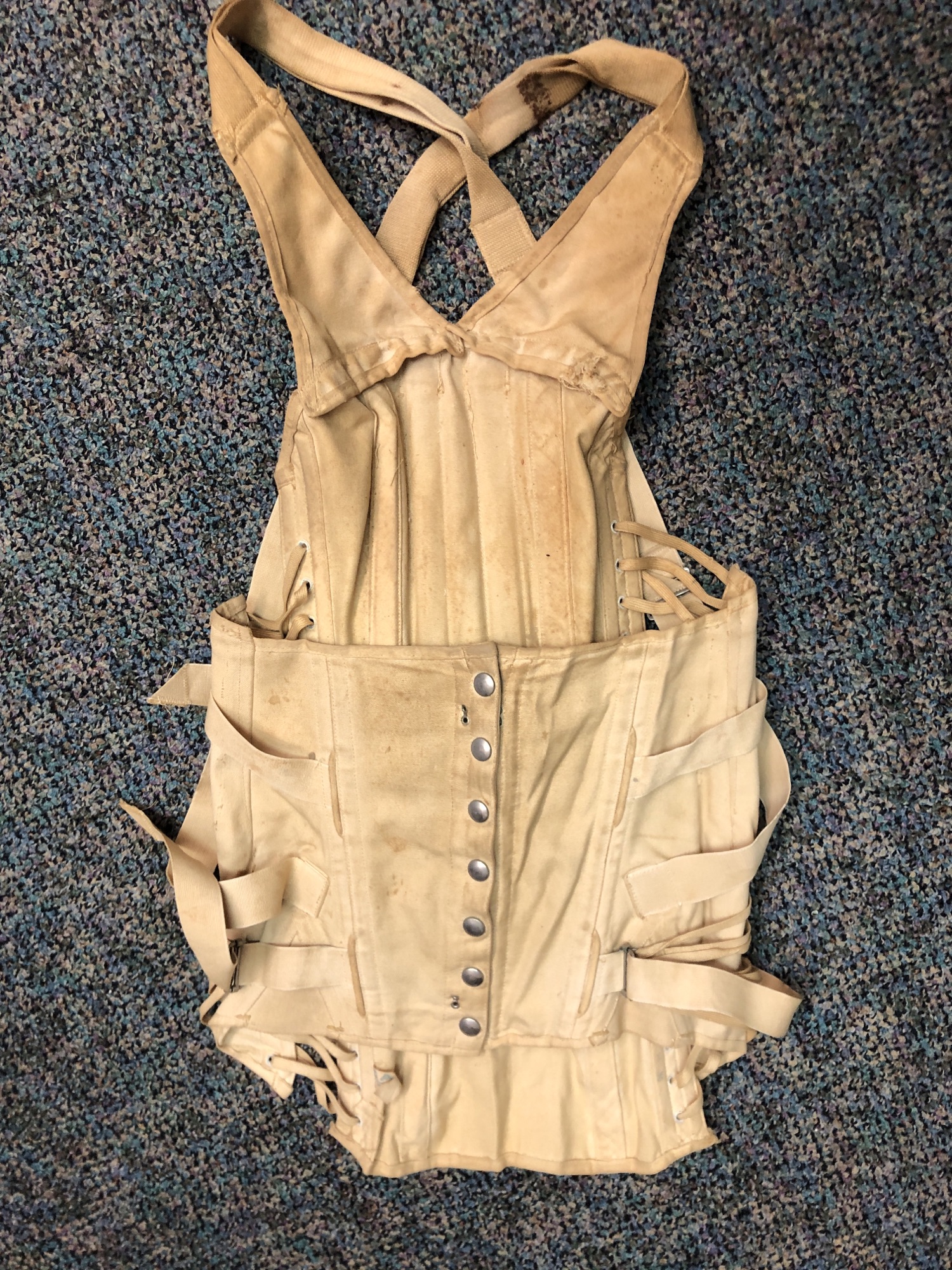
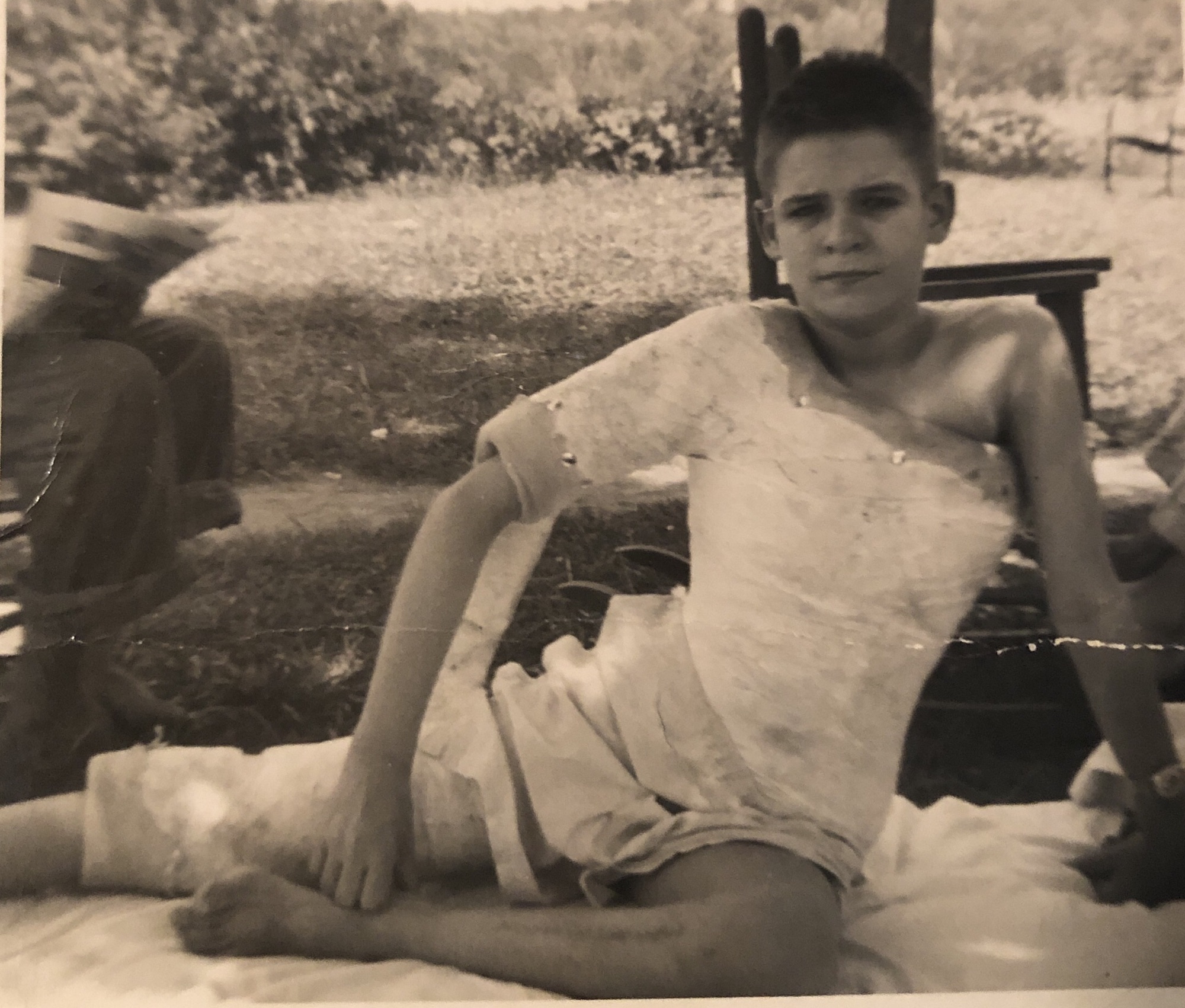
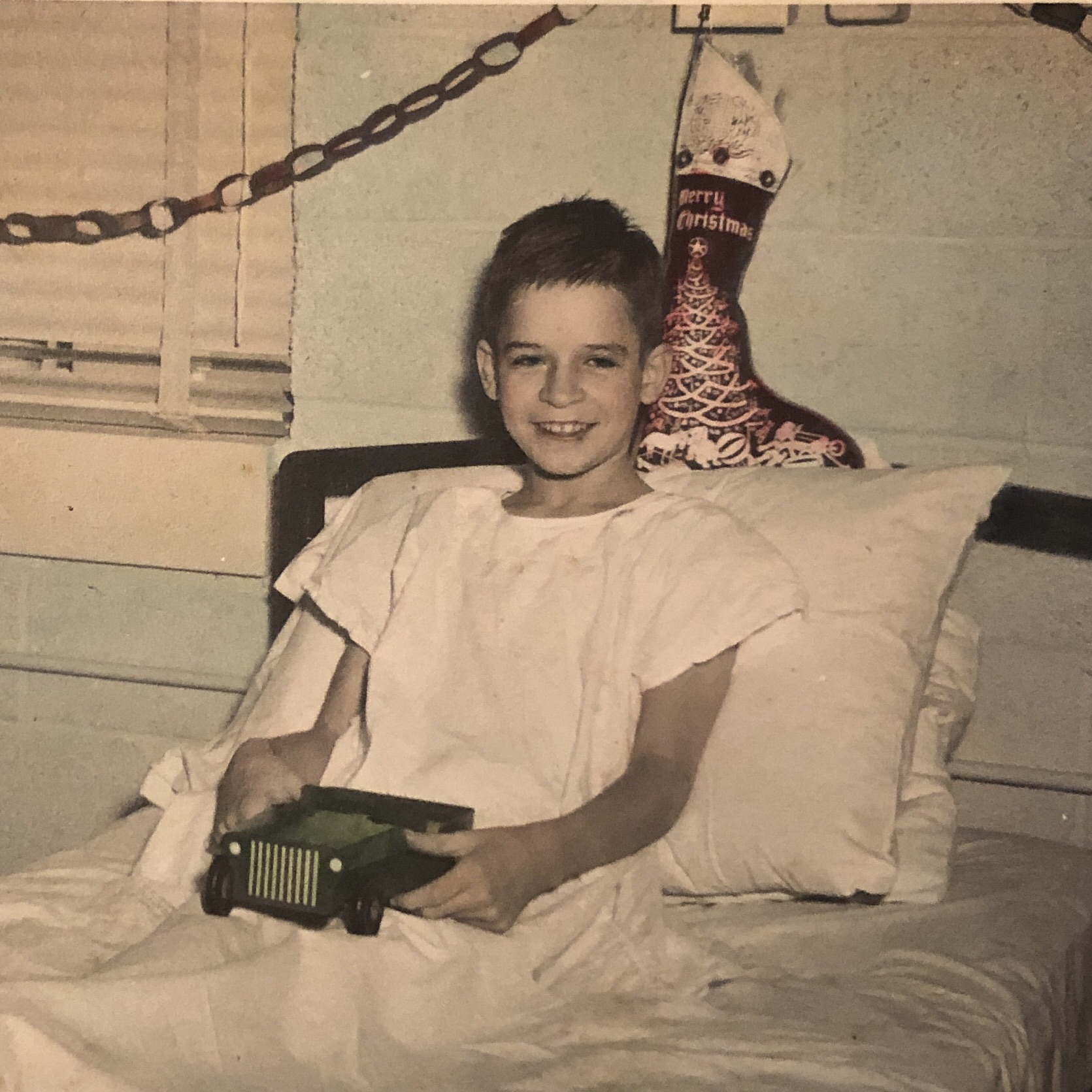
On top of the box was the brace Dad wore on his torso as he healed from Polio which he contracted when he was ten years old. The virus stole him away from his family as he spent his eleventh and twelfth birthdays in the hospital. Miraculously, Dad was the only one to contract the virus in his family, which included eight siblings, his father, and his five months pregnant mother. Throughout my childhood, I had seen the pictures of Dad hanging out in his hospital bed, playing with an Army jeep he had been given for Christmas; Dad in his post spinal surgery cast that went from just above his right elbow, covered his torso, then ended just over his right knee. I had asked many questions, unable to fathom what it must have felt like to that little boy who had, literally, never spent a night when he wasn’t inundated with siblings on all sides to find himself seventy miles from home in a sterile hospital bed, flat on his back, day in and day out for months on end. I held the slender corset up and felt again the stabbing pains of loneliness and homesickness I have always imagined filling those days. I imagined the pain, too, that my grandparents must have felt having to leave their ten year old son there so that they could care for the other children at home. After working hard all week running the farm and caring for all their other children, on Sunday afternoons Dad’s parents would drive from Harmony to Greensboro to spend an hour or two swaddled in protective clothing to visit their son. As Dad awoke alone on Christmas Eve 1948, four months since he had been taken to the hospital in Greensboro, his mother gave birth to the last of her children, Willa, her only hospital birth, who was born by Caesarean.
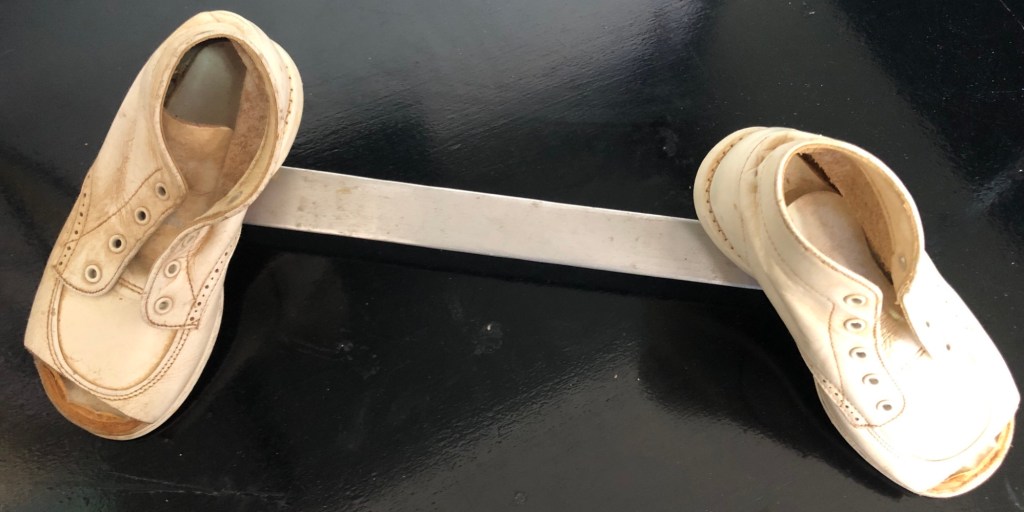
Underneath Dad’s back brace was my own brace. This one featured two tiny shoes mounted onto a silver metal bar. The shoes are called Baby Beaver Walkers according to the logo on their bottom sole. I just adore that name! The contraption, not so much. The bar the shoes are mounted to features two knobs that loosen and tighten to turn the shoes to an angle from -80 to +90 degrees. Some of my earliest memories are of awakening, sliding out of the bed with my feet shackled together, then going to my knees to crawl up the hall to my parents’ bedroom to have the corrective shoes removed. I’m not sure how old I was when I started sleeping in this device that was intended to correct my pigeon-toed left foot, which I, apparently, inherited from my dad. Prior to Polio, young Carl was also pigeon-toed. After lying flat on his back for months, he progressed to sitting up in bed, standing beside the bed, then learning to walk all over again. His physical therapist was determined to correct his gait, so she made him walk between two rows of bricks so that his feet had to align as he walked. Maybe my own doctor should have adopted that approach. Though I wore the corrective shoes every night long enough that the toes had to be cut out to accommodate my growing feet, still, at almost fifty-nine, I am pigeon-toed. My left shoe tends to scuff the toe of my right shoe, especially when I am tired. The brace brings up early feelings of craving freedom, independence. I like to imagine myself in the scene from Forrest Gump, the brace falling away as I took off at a full run.
I wonder if the Baby Beaver Walkers had anything to do with my love/hate relationship with shoes? Probably not. That probably came from the years when I could not wear normal shoes. Several years ago, I reconnected with my beloved third grade teacher, Mrs. Livingston, on Facebook. As soon as she saw the Friend’s Request, she accepted and then sent me a sweet note: “I remember you! The skinny, blonde girl in my class who couldn’t wear closed in shoes.” Ding! Ding! Ding! You’ve got the right girl! About the time I started school, my feet began to break out in a horrible rash, mainly centered on my toes. The toes would crack open and bleed and pus would stick my socks to my feet like Super Glue. I’ll never forget the first visit to Dr. Michener, the Allergist, in Charlotte. He took me back to a room, had me remove my shirt, then proceeded to stick me in the back with several dozen needles. Each skin prick was covered with a round Bandaid. I was back in about a week for the verdict: I was allergic to the glue that nearly all manufacturers used in shoes. Daily Prednisone would clear up my problem, then we would try a different pair of shoes and I was right back to full breakout mode. At the height of my struggle my brother-from-another-mother, Jeff Elliott summed it up perfectly on a beach trip with our family. As we sat eating lunch at Maryland Fried Chicken, he held up a Tater Tot (the first Tots we had ever seen) and announced, “Hey, these look just like Robin’s toes!” He was correct. The only solution was molded plastic or rubber form-molded shoes that contained no glue. These were the types of shoes you can buy to this day in a beach shop, sort of precursors to Crocs, only without the cool element. Spring, Summer, Fall or Winter, I wore these open-toed shoes (with socks if it was cold, without if it wasn’t). Nearly fifty years later, it was still so odd a detail that my third grade teacher remembered it!
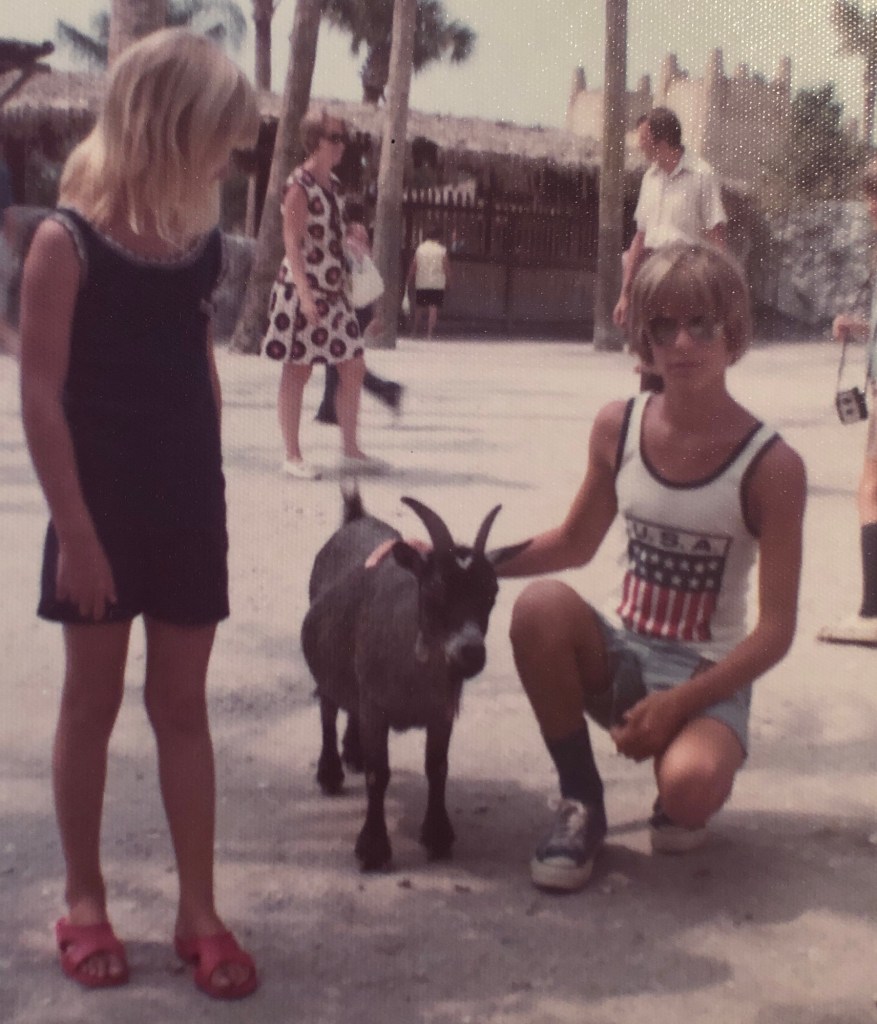
I was probably still in Mrs. Livingston’s class when a miracle happened! Mom and I were shopping at Collins Department Store at Freedom Village Shopping Center and we discovered a pair of black and white saddle oxfords that had sewn-in insoles … with NO GLUE inside them. Sold!! I had always wanted to try out for Long Creek Optimist Club cheerleading, but had been held back by the fact that I could not wear closed-in shoes. It seemed like an omen that the first shoes I could wear in years were saddle oxfords.
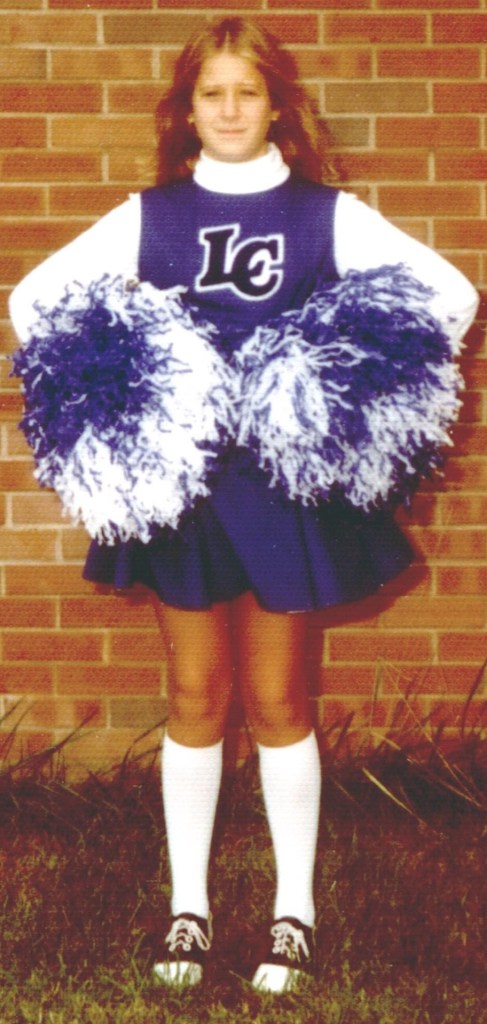
As I moved the braces aside, Dad’s and mine, the next thing in the box was my Long Creek Mustangs cheerleading dress and bloomers. Back then moms or sewing neighbors made our cheerleading dresses. I got mine as a hand-me-down from my neighbor across the street, Sherry Cantrell, who I just happened to think was the prettiest girl in the neighborhood. For several years, I had watched her cheer from the sidelines and wanted to be just like her. Holding up her cheerleading outfit, my cheerleading outfit, tears sprang to my eyes. Those saddle oxfords were my ticket to ride! I tried out for cheerleading and made the squad (though I am not sure there was anyone who tried out that didn’t make the squad)! I absolutely loved those cold Saturday mornings cheering the Mustangs on, my saddle oxfords wet with dew. I especially loved Saturdays when we had home games at Long Creek Elementary School since my Dad was usually working the concession stand and I could grab a Coke and popcorn or a hot dog after our game was over and he would foot the bill.

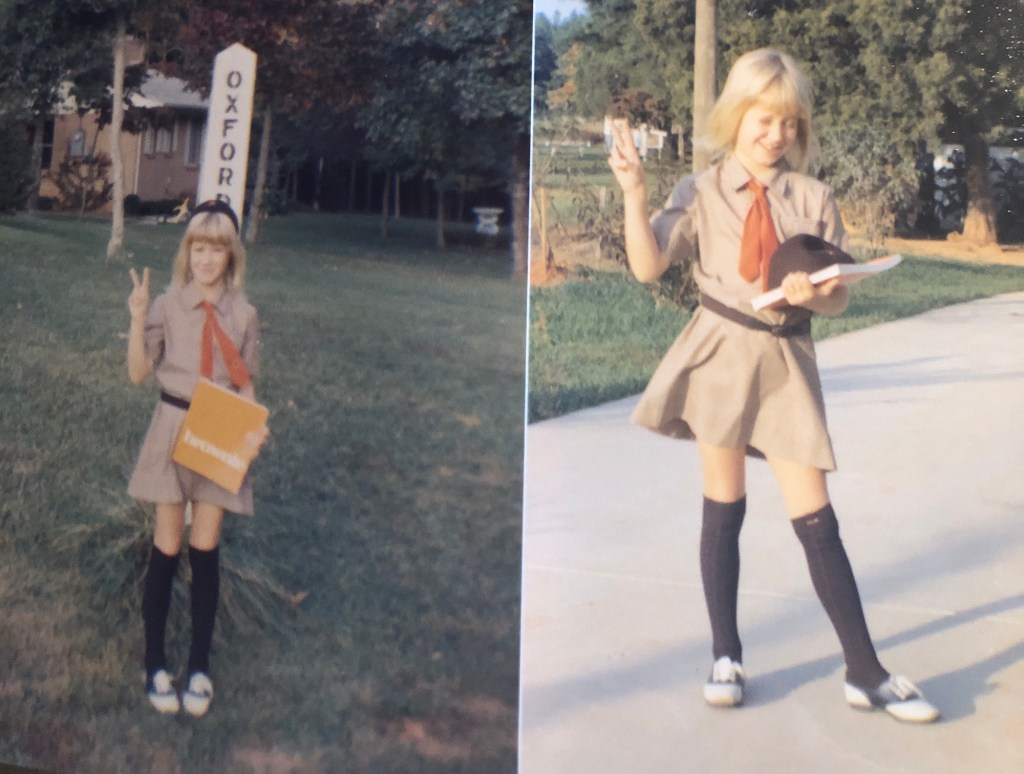
Underneath the cheerleading outfit, I found my Brownie beanie and my Girl Scout beret. The Brownie beanie immediately reminded me of one of my favorite childhood photos of me. I am wearing my full Brownie regalia (and my saddle oxfords) while holding the Brownie Handbook in one hand and making a peace sign with the other. Pulling it from the Ziploc bag I had stored it in, I popped the small beanie on my head, held up three fingers and recited, ‘On my honor I will try to do my duty to God and my country, to help other people at all times, and to obey the Girl Scout laws.’ Brownies and Girl Scouts were programs of our church, Hopewell Presbyterian. Brownies was run by Mrs. Pat Dellinger, the mother of one of my classmates. I loved her dearly. When I graduated to Girl Scouts, our leader was Marian Alexander, a wonderful nurse from my primary doctor’s office who I had always admired. These ladies and the couple who led our church Youth Group, the McMurrays, were as influential and important to me as my school and Sunday school teachers. They taught me to be more confident and encouraged me to be a good student and a good citizen. Always the overachiever, I remember selling the most Girl Scout cookies in the troop one year as a major accomplishment. Back then we went door-to-door and made phone calls to sell. There was no setting up in front of the local Kmart (and Walmart didn’t exist). We sent our order forms to work with each of our parents, harassed all of our relatives to order, and hurried home from the meeting where our order forms were passed out to beat every other girl in the neighborhood to the doors of our neighbors to get their orders for Thin Mints, Trefoils and Peanut Butter Sandwich cookies.

Next I unearthed my Mickey Mouse souvenir ears, complete with “Robin” stitched in gold across the back. The trip to Disney was never spoken of without mentioning that I showed up at the park the first day barefoot. How it wasn’t noticed when we got in the car at Daytona Beach or anywhere along the way, I don’t know. You’d think someone would have checked since I had previously shown up at the USS North Carolina Battleship in Wilmington barefoot the summer before. Dad had had to carry me on his back across the scorching August-hot deck of the ship. As we popped out of the car and began to lock it up to approach the ticket booths at Disney World, Mom looked down and asked, “WHERE ARE YOUR SHOES????” The answer? Right where I had taken them off when we got to the beach. For obvious reasons, I hated shoes and never wore them voluntarily (until I became shoe obsessed as a teenager). We all got back into the car, pulled out of the pay lot, and went to a souvenir store right outside the gate. The only shoes they sold were flip flops that were at least two or three sizes too big for me. That’s what I wore to the park that day. I don’t remember it slowing me down much. I remember most the “It’s a Small World” ride, because it was cool in every sense of the word. We escaped the August heat and were entertained by hundreds of animatronic dolls dressed in authentic costumes from all over the world. It felt like being inside a storybook.
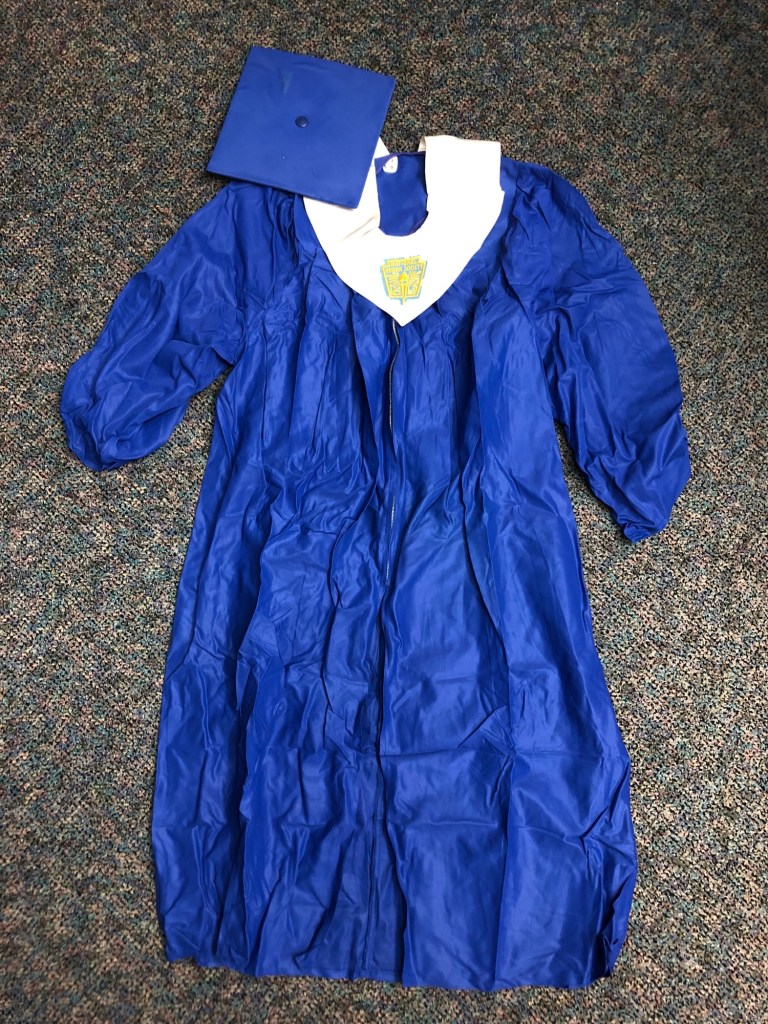
The last treasure in the box of memorabilia was my cap and gown from my graduation at North Mecklenburg High School. My gold and blue tassels were missing (last seen hanging from my car’s rear view mirror during Senior Week at Myrtle Beach), but my Honor Society collar sash was there, looking like it did when I graduated in 1983. There had been nothing stored in the box from my junior high years. No surprise there. I wanted to forget those. The cap and gown, the sash, brought back a million memories from some of the best years of my life. I, regretfully, sold my high school class ring when gold prices were high, figuring I’d never worn it once I got the college ring. Still, I wished immediately that I had kept it for the nostalgia. The cap and gown were a good substitute. Memories of Putt Putt and Eastland Mall, football games and Godfather’s Pizza afterwards, and dates with my future husband, Darryl, at Darryl’s Restaurant and in the courting room at my childhood home flooded in as I held the robe in my hands for the first time in 40 years. It’s sad none of those places exist as they were anymore other than in memory.
Times have certainly changed, though I have managed to hang onto the high school sweetheart for over forty years. I rarely look back, so this trip down memory lane was novel and filled with every emotion in the book. I was certainly blessed to grow up in Long Creek in the 1970s and 80s. My brother and I were blessed with and surrounded by good parents, good families, good friends, good neighbors, good teachers, good preachers. It was a safe and mostly happy place and time that I long for today. While I outgrew the allergy to the glue in shoes and went on to own what my husband would say is more shoes than Imelda Marcos, I still prefer to be barefoot any time I can. I’d give a lot to be able to live now in a place and time like I grew up in. I’d give a lot to have things so simple today that showing up somewhere without shoes was the biggest problem of the day.
 Robin's Eggs